Ravenloft
The Apparatus of the Alchemist
Mysterious Alchemical Device of Mordentshire
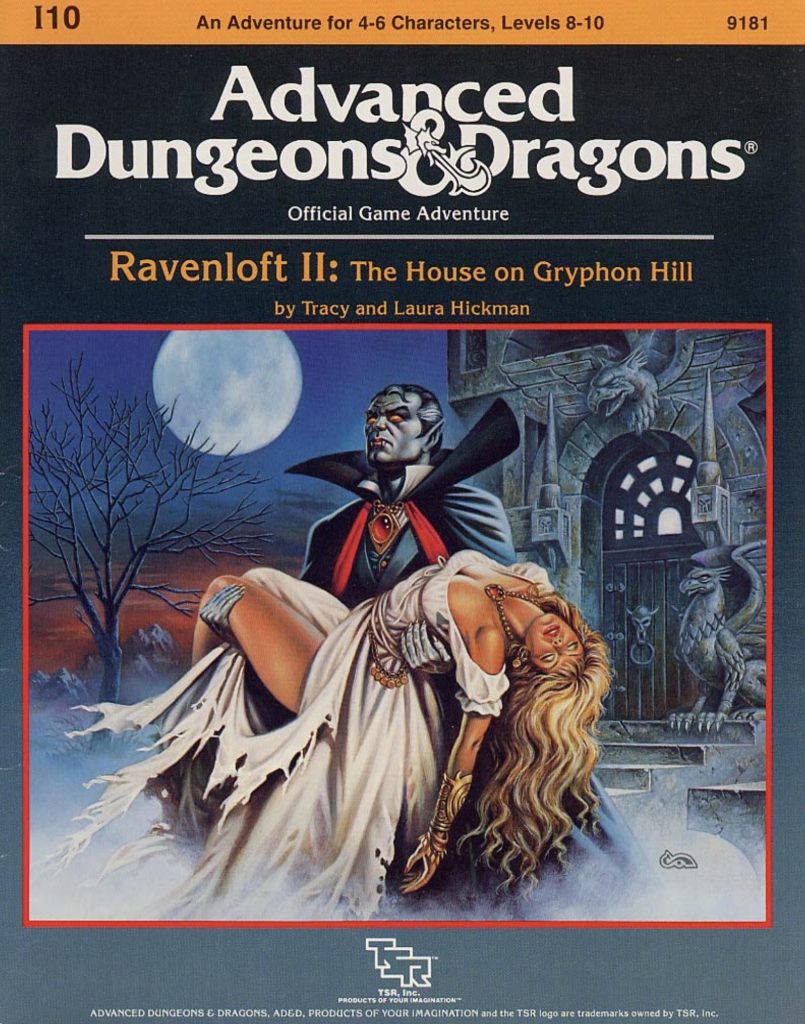
A Source Analysis of I10 Ravenloft II: The House on Gryphon Hill
The Apparatus of Gryphon Hill is treated in almost every discussion of I10 as a plot device: the thing the players must locate and activate to defeat the Creature and end the adventure. This article examines it as a subject in its own right.
One framing note before proceeding. The Peculiar History of the Kingdom of Barovia has established what the Apparatus did to the timeline and why the Creature is who he is. That reading is assumed here and not re-argued. It is worth noting that I10’s own Dreams of Barovia appendix plants the seeds of that reading directly: the module names the connection between Barovia and Mordentshire a bridge, describes the two worlds as “miles and perhaps centuries apart,” and explicitly offers three valid interpretations of their relationship, of which the parallel and equally real reading is one. The Peculiar History develops what the module itself puts on the table. What this article examines is the machine itself, on its own terms, from I10’s own text.
A second framing note. The Apparatus operates in what I10 consistently calls soul language: the machine separates, exchanges, and reunites souls. This is not a neutral technical vocabulary. It is the vocabulary of the man who built the machine, a medieval alchemist examining the problem of evil in a person, for whom soul was the only available term for the thing he was working on. Whether soul is what the machine is actually operating on, in the theological sense that AD&D assigns to the term, is one of the questions this article addresses.
The Physical Object
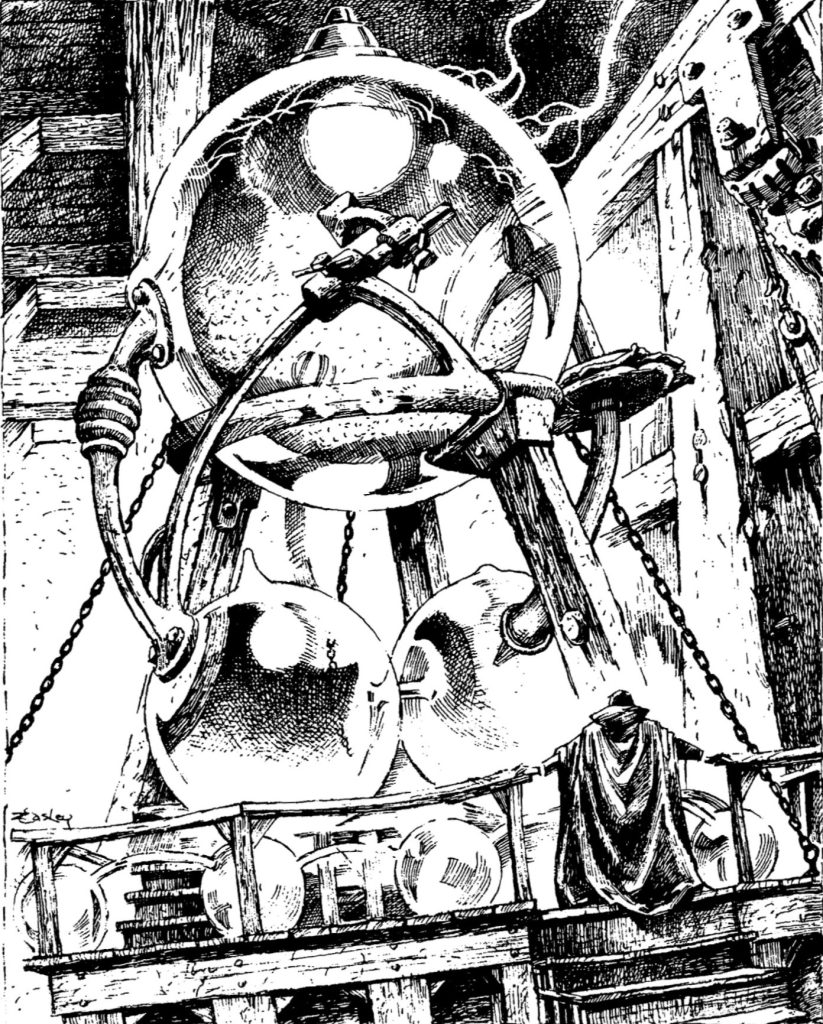
The Apparatus is described in I10 as a great and terrible achievement. It sits in a large room, over two stories tall. A great network of cold-forged steel rings focuses the power of lightning strikes into a great globe in the dome overhead. The energy is stored and converted into a spinning ball of sulphur encased in a fifteen-foot glass globe. This force is channelled into a bank of small spheres at the base. From there it is focused into a pair of glass chambers where subjects are held.
It is a lightning-powered machine. Its energy source is the storms that batter Gryphon Hill, drawn down through the steel ring network and stored in the sulphur globe before being directed through the spheres to the subject chambers. The cold forging of the rings is a detail worth noting: cold forging is a precise and laborious process that produces harder, more carefully shaped metal than hot work. The Apparatus was not quickly made.
The Rod of Rastinon is the control element. Without it, the machine performs only the exchange of consciousness between two subjects. With it, the full range of operations becomes possible: union and splitting as well as exchange. The Rod is a crystal shaft, approximately two feet long, with silvery sparks occasionally crackling inside. It is, like the Apparatus itself, fragile. A determined effort to break it carries a cumulative chance of success with each attempt. If it is destroyed, the module states plainly that only the destruction of the Apparatus itself can resolve what has been set in motion. The Rod and the machine are inseparable as a functional pair.
The Apparatus is also portable, or at least moveable. I10 places its current location through a randomisation mechanic across six possible sites, all of them either in the Gryphon Hill estate or locations the Creature controls. It was originally built in the Abandoned Lab at Gryphon Hill, and the physical evidence of its removal is still there when the players arrive: ropes, pulleys, beams, and scaffolding dangling from the walls and ceiling, converging on a large central area where something large once stood, and great gouged tracks in the earthen floor leading to the iron doors at the back of the chamber. The machine was built in this room and dragged out of it.
The Operations of the Apparatus
Before the deeper analysis, it is useful to state plainly what I10 claims the machine does and does not do.
Without the Rod of Rastinon, the Apparatus performs a single operation: the exchange of what I10 calls souls between two subjects. What transfers is the full mental life of a person: knowledge, awareness, personality, mental capabilities, and accumulated identity. What does not transfer is physical capability. The body retains what it is. The consciousness brought into it retains what it knows and is.
With the Rod, the full range of the machine’s intended operation becomes available: not just exchange but the splitting and reuniting of souls.
I10 states that the exchange transfers mental abilities but not physical ones. It is also clear, in the Creature’s various guises through the adventure, that certain physical properties of his vampiric nature manifest in host bodies that are not his own. This tension is noted here and addressed fully in the analysis below.
A Year at Gryphon Hill
I10 establishes the core chronology clearly. The Alchemist arrived in Mordentshire approximately one year before the adventure begins. He purchased the Gryphon Hill estate, which had stood empty and ill-regarded for generations before him, and moved in as a new arrival: a young-seeming alchemist and sage, pleasant in manner, dealing in transmutation of some kind. He took dinners at Heather House, where he met Lord Byron Weathermay and his daughter Virginia, and became engaged to her.
Somewhere within that year, he built the Apparatus in the Abandoned Lab at Gryphon Hill.
The physical evidence of the construction project, the scaffolding, the pulleys, the ropes, the two-story space required, indicates this was not a quick assembly. The Apparatus required time, materials, and engineering that the Alchemist had clearly been preparing for. Whether he arrived at Gryphon Hill already knowing what he intended to build, or developed the project after his arrival, I10 does not say. What the module does establish is that the building of the machine occupied a substantial portion of his year there, because the activation came after the construction, and the Creature’s arrival came after the activation, and between the activation and the Creature’s arrival the Alchemist had already met and become engaged to Virginia. That sequence requires time.
What I10 does not tell us is what the Alchemist’s history was before Gryphon Hill. He is young-seeming for his knowledge, which is noted as unusual. He arrived already in possession of the expertise required to build one of the most extraordinary devices in the Ravenloft canon. The Peculiar History’s reading, that the split created two divergent timelines rather than two beings simultaneously in one world, implies that the Alchemist has lived an entire life in his own timeline, reaching this point by his own path. What that path was is not I10’s subject. Gryphon Hill is where the module finds him, and Gryphon Hill is where the story of the Apparatus begins.
On a stormy night, the Alchemist tested the machine on himself. The module describes what happened through his own diary entry, written in panic on the night it occurred: he had been working to perfect the device when it fled his control, and his dark self returned as the Creature, emerging physically from the shattered globe. He fled the house in terror.
The diary entry is this article’s primary evidence for this event, and its register tells us as much as its content. He does not describe the activation with the measured language of a successful experiment. He describes it as a nightmare made real. The machine worked. It did what he built it to do. And the result was not an improvement. It was a physical adversary who stepped through the shattered globe and declared himself the hunter.
The Arrival and the Catch-Up
The Creature arrived on the night of the activation, emerging from the shattered globe of the Apparatus itself, stepping into Gryphon Hill and from there into Mordentshire. He arrived in a world he did not know, in a town he had never seen, in a century whose customs and inhabitants were entirely foreign to him. He had the stolen Apparatus, the cunning of centuries, and nothing else.
The asymmetry of this moment is worth dwelling on. The Alchemist had spent months or more establishing himself in Mordentshire. He had a house, a reputation, a fiancée, a social position. He had built the machine that made this ordinary life possible, and it had worked: the darkness was gone, the good half was free, and a life he had not expected to have was beginning to take shape in this quiet coastal town. Then, on a stormy night, the dark half arrived and all of it was in jeopardy.
The Alchemist’s response was to flee to Heather House and place himself near Virginia. He was not prepared for this contingency. The machine was designed to expel his darkness, not to produce a physical adversary who would emerge from it and come hunting him. His diary reveals a man in genuine panic, trying to protect the thing he has only just obtained.
The Creature’s stated motivation for Virginia is explicit in the dream confrontation the module stages between them. He declares she will be his, that she was denied him as Tatyana was denied him. This is the Creature asserting a parallel, not the module establishing one. I10 gives Virginia no connection to Tatyana beyond the Creature’s own identification of her as something he has been denied. Whether that identification reflects something the module intends or is simply the pattern a consciousness shaped by centuries of loss and obsession imposes on whatever it most wants, I10 does not resolve. What is clear is that Virginia’s existence in the Alchemist’s life is part of what the Creature cannot tolerate about the situation he has arrived into.
The Creature’s response was the opposite of panic. He is described in I10 as the ancient, the land, the original, and the module is consistent throughout that he is of genius intelligence and is not easily fooled. What he lacked in local knowledge he compensated for with centuries of strategic patience. He did not immediately confront the Alchemist. He began building position.
The systematic conversion of Mordentshire’s population using the stolen Apparatus was the Creature’s first project in this new world. It is the direct equivalent of what he does in Barovia: establish control over a human population, create assets in place, build a network of loyal or compelled servants. In Barovia this took centuries. In Mordentshire he has been doing it for weeks or months by the time the players arrive, and it is already well advanced. He is playing catch-up with the tools of a genius who has been playing this game for a very long time.
This is also why the Creature operates through guises rather than confronting the Alchemist directly. He is not ready for that confrontation. He needs the Rod, he needs the Apparatus operational, and he needs the Alchemist within reach at the moment he chooses. Everything he does in Mordentshire is preparation for a specific goal, and the systematic conversion of the town is the means by which he makes the environment hostile enough to that goal’s adversaries that the goal becomes achievable.
What It Was Designed to Do
The Apparatus was designed to separate evil desires from the soul of its creator. This is the module’s own summary, and the Alchemist’s own framing, and it is worth examining carefully because the framing itself is part of the problem.
Evil desires is not a technically precise description of what was separated. The Alchemist experienced something he could not live with, a darkness in himself that he regarded as incompatible with the person he wanted to be. He built a machine to remove it. The machine produced two physical beings, one carrying the good half and one carrying the dark half, in two divergent timelines. He called what was removed his evil desires, his darkness, the shadow of himself, because that was the vocabulary available to him. Whether what was actually separated was the theological soul, or the accumulated identity and consciousness of a person, or something else entirely, is a question the Alchemist’s vocabulary cannot answer. He named what he experienced, not what he engineered.
The module delivers its own verdict on this project through the Alchemist’s own words. He calls it pride. Not ambition. Not despair. Not the tragic passion of the conventional Strahd narrative. Pride: the conviction that the problem of evil in a person is a technical problem with a technical solution. The man who built a machine to remove his darkness named his error correctly when he reflected on it. He believed he could separate himself from the part of himself he did not want, as though identity were divisible without remainder. The machine proved he was wrong. What it produced was not a purified self and a discarded shadow. It was two selves, each incomplete, each in its own way incapable of what the whole would have been capable of.
What It Actually Does
Without the Rod of Rastinon, the Apparatus performs a single operation: the exchange of what I10 calls souls between two subjects. What transfers in this exchange is everything that constitutes a person’s mental life: spells, mental abilities, mental immunities, awareness, reflexes, and mental attack modes. What does not transfer is physical capability. The body retains what it is. The consciousness brought into it retains what it knows and thinks and is. A monster placed in a human body retains its knowledge and its awareness but none of its natural physical capabilities. A human placed in a monster’s body retains her own knowledge and awareness alongside the physical form of the monster, which may carry instincts that press uncomfortably against the human consciousness now inhabiting it.
The module notes a peculiar effect of this exchange on the detection of alignment. When someone attempts to discern the nature of a transpossessed person, the result is confused, often reading as neutral rather than accurately reflecting the consciousness now present in the body. If the saving throw succeeds, the detection reads as the nature of the original consciousness. If it fails, the reading is confused and unhelpful. This is how the Creature conceals himself across his various guises in Mordentshire, and it is the one detail in the Apparatus’s mechanics that points most directly toward the soul versus consciousness distinction.
With the Rod, the full range of the machine’s intended operation becomes available: not just exchange but union and splitting. This is the operation the Alchemist designed it for. The Rod completes the separation function, and it is what the Creature needs to achieve his final goal. It is also what the players need, in the hands of the Apparatus, to reverse what the Creature has done to Mordentshire and destroy him.
The Soul or the Consciousness
I10 uses soul language throughout its description of the Apparatus and its companion items. The Apparatus exchanges souls. The Ring of Reversion restores souls. The Soul Searcher Medallion perceives souls. This is not solely the Alchemist’s vocabulary imported into the narrative. It is the designers’ own chosen register, and it is used consistently across the module’s mechanical and descriptive text alike.
The problem is that soul in AD&D has a defined technical meaning that sits in tension with how the module uses the word. Under the standard AD&D model, the soul departs the body at death and negative energy animates what remains. The soul can be captured, raised, or destroyed by specific means, but it is gone from the undead body. This is what distinguishes a vampire from a living person in the game’s own cosmology.
If the Apparatus operates on souls in that precise technical sense, it should have nothing to work with in the Creature’s vampiric body. Yet I10 is clear that the Creature can be exchanged, split, and reunited like anyone else. The designers did not notice the contradiction, or did not consider it relevant to the adventure’s function, because soul was the dramatic register they needed. Soul carries weight that consciousness does not in a fantasy context. It is the word that makes the machine feel like what the Alchemist intended it to be: an instrument working on the deepest and most essential part of a person.
What the Apparatus actually manipulates, and what resolves the contradiction with the game’s own cosmology, is consciousness: the continuous thread of identity, memory, awareness, will, and personality that persists in intelligent undead after the theological soul has departed. This is what the Creature has. This is what the machine works with. The Alchemist may have understood some distinction between essence, will, memory, and moral nature, even if his natural vocabulary defaulted to soul. The designers almost certainly meant something close to this when they wrote the module. They reached for the literary word rather than the technical one, and the literary word happens to create a contradiction that the technical word resolves.
Whether consciousness and soul are ultimately the same thing is a question that remains genuinely unresolved in philosophy and theology. The Alchemist could not have known, and neither can we. What the rules and the module together establish is narrower but firmer: when the Apparatus works on undead, it works on something that survives the soul’s departure. The designers called it a soul because that was the word the story needed. What the machine actually moves is closer to consciousness. He built something more precise than the language used to describe it, and the language has been creating unnecessary confusion ever since.
The Contradictions That Remain
The consciousness reading resolves most of the internal tensions in the Apparatus’s operations as I10 describes them. It does not resolve all of them.
One inconsistency persists in the module’s own account of the Creature’s guises. The text establishes that transpossession transfers mental abilities but not physical ones. A monster’s consciousness in a human body retains knowledge and awareness but not natural physical capabilities. This principle is stated clearly and it is mechanically sound under the consciousness reading: consciousness is not body, and moving consciousness does not move body.
Yet in several of the Creature’s guises, the host body manifests physical properties that should not, under the stated principle, be present. Lady Weathermay in the Creature’s possession has no reflection. His other guises carry physical vampire characteristics, the absence of shadow, the presence of fangs, the susceptibility to daylight, in bodies that are not his own. The module presents these as natural properties of his possession of the body, but they contradict what the Apparatus is stated to do.
This inconsistency does not have a clean resolution. The consciousness reading accommodates some of it: the Creature’s vampiric nature is so thoroughly interwoven with his identity that aspects of it manifest even through a borrowed body, the way extreme personality can alter the presentation of a person regardless of circumstances. But this is a softening of the problem rather than a solution. The module is not fully consistent on the question of what physical properties follow consciousness across a transpossession, and that inconsistency is genuinely there in I10’s own text.
The Machine as Weapon
The Apparatus the Creature uses in Mordentshire is not the machine the Alchemist designed. It is the same physical object repurposed for an entirely different end.
The Alchemist built it for a single self-directed operation: the removal of his own darkness. The Creature uses it as a population-conversion engine, systematically placing evil consciousnesses into the bodies of Mordentshire’s inhabitants and relocating the human consciousnesses elsewhere. The machine designed for one act of self-improvement becomes an instrument for the wholesale transformation of a community from the inside.
The module can be read as making an argument through the machine’s history. A tool built on the premise that evil can be cleanly separated from good will, in the wrong hands, separate evil from good in the worst possible way: by removing the good from every human body it can reach and leaving something else in its place. The machine is perfectly suited to this repurposing because its operational logic is neutral. It moves consciousness. It does not judge what it moves. The Alchemist’s moral purpose was not a feature of the machine. It was a feature of the Alchemist. When the machine passes to the Creature, the moral purpose does not come with it.
The Creature’s use of the Apparatus in Mordentshire also reveals something about his strategic intelligence. He is building in this unfamiliar town the same architecture of control he has spent centuries constructing in Barovia: a human population in which loyalty and resistance are indistinguishable from the outside, in which his assets are hidden in plain sight, in which the social fabric of the community has been systematically hollowed out and replaced with something that serves him. He is doing in weeks what took centuries in Barovia, because he now has a machine that does directly what he previously had to accomplish through the accumulated pressure of fear and isolation.
What the Apparatus Tells Us About I10
The machine is I10’s argument in physical form.
The Alchemist built it because he believed evil in a person is isolatable. He believed the darkness in himself was a separable component, that a sufficiently precise instrument could find the boundary between what he was and what he did not want to be, and divide along it cleanly. The machine proved he was wrong, not by failing, but by succeeding. It found the division he believed in and made it real. What it produced was not a purified self and a discarded remainder. It was two incomplete beings, each lacking what the other carried, each unable to do what the whole could have done, existing in parallel rather than in resolution.
The Alchemist is pleasant and capable and living an ordinary life, but he is untested by the darkness that tested Strahd and produced everything I6 documents. He does not know what he is missing because what he is missing is precisely the part of himself that would have told him. The Creature is powerful and enduring and possessed of centuries of accumulated experience, but he cannot rest, cannot find satisfaction, cannot stop hunting. He is driven by the absence of the half that was removed. Neither half is Strahd. Both halves are Strahd. The machine produced this situation correctly and perfectly and in doing so demonstrated that the premise on which it was built was false.
The Creature’s repurposing of the machine as a weapon against Mordentshire is the final expression of this argument. The instrument built to resolve the problem of evil by removing it from one person is used to install evil in everyone. The machine works in both applications. Its operation is neutral. What it does with consciousness depends entirely on what the person operating it wants. The Alchemist wanted to be free of his darkness. The Creature wants to be free of his incompleteness. Both are using the same machine in pursuit of the same underlying goal, approached from opposite directions, and neither will find what they are looking for in it.
The machine cannot redeem anyone. It can move things around. The Apparatus of Gryphon Hill is the most precise instrument in the Ravenloft canon, and the most honest demonstration of the limits of precision.
Conclusion
The Apparatus was built by a man who believed that the problem of evil in himself was a technical problem. He was a sufficiently skilled alchemist and engineer to build an instrument capable of addressing it. The instrument worked. The problem it solved was not the problem he thought he was solving, and the consequence of its success, two divergent beings pursuing each other across the boundary between worlds, is the subject of I10’s entire adventure.
By the time the players arrive in Mordentshire, the machine is in the Creature’s possession, the Alchemist has fled his house for the safety of a fiancée’s home, and the town is in the early stages of the systematic dismantling that the Creature has been practising for centuries. The Apparatus sits somewhere in the Mordentshire area, enormous and fragile, still drawing power from the storms, still capable of everything it was built to do. What happens to it at the adventure’s end, in the cliff-edge confrontation the module stages as its climax, is the one moment in which the machine performs something closer to its original purpose: not resolution, not redemption, but an ending.
The Alchemist named his error correctly. Pride. The conviction that this was a problem he could solve. He was right that it was a problem. He was right that he could build something capable of addressing it. He was wrong about what solving it would look like. The machine is still right. The understanding was always the problem.
Sources
I10 Ravenloft II: The House on Gryphon Hill, based on an outline by Tracy and Laura Hickman, TSR Inc., 1986.
The Peculiar History of the Kingdom of Barovia, Drew Griffiths, Vaults of the Odd.
Comments