Greyhawk
A Treatyse of Fysshynge wyth an Angle
No sound? On iPhone and iPad, read-aloud follows the silent switch — turn silent mode off to hear it.
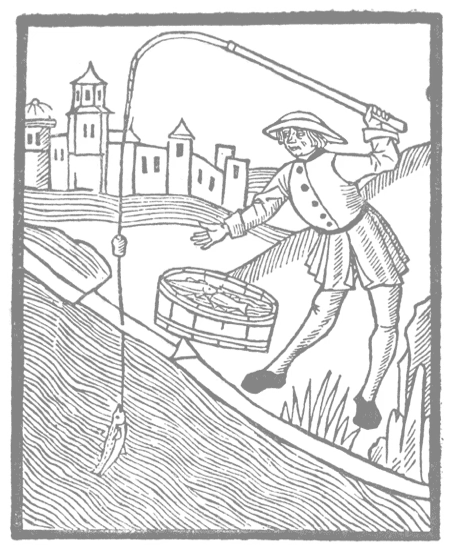
The cover of this book is titled The Art of Coarse Angling, yet its first page gives a different title altogether: A Treatyse of Fysshynge wyth an Angle, by Juliana De Berners.
It is a comprehensive treatise describing the theory and practice of freshwater fishing. Anyone who takes the time and effort to study it will have less difficulty catching fish from river or lake.
It is a book of many oddities. Among the details of its publication it gives “Wynkyn De Worde, Westmestre” and a date of 1496. It does not appear to be hand-written, nor hand-illustrated: the words and illustrations are somehow stamped onto the pages, in a writing style difficult to understand. It defies magical translation, for it appears to be already readable.
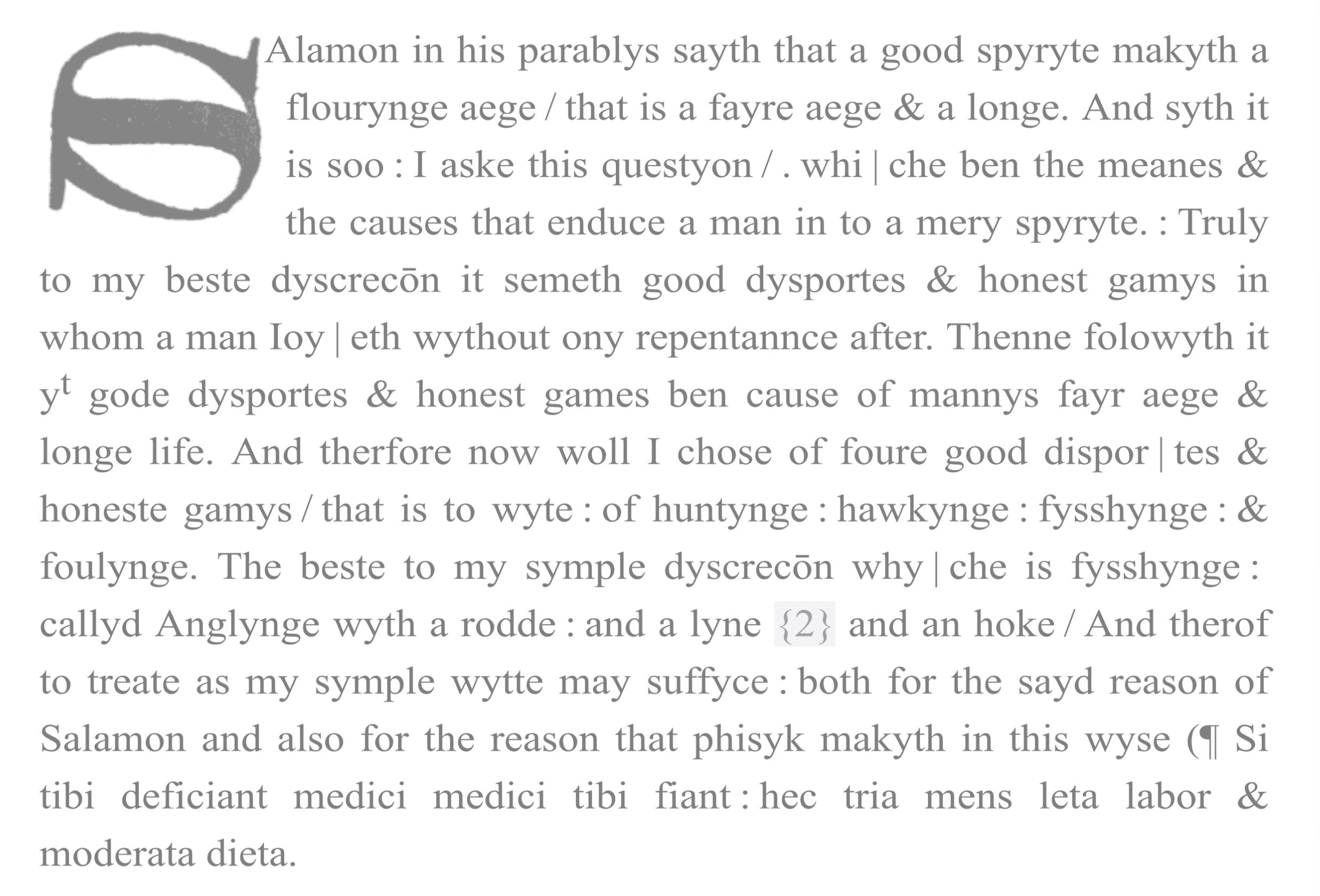
A sample of the book’s own hand — stamped, yet plainly legible — runs thus:
Salamon in his parablys sayth that a good spyryte makyth a flourynge aege / that is a fayre aege & a longe. … The beste to my symple dyscrecōn whyche is fysshynge : callyd Anglynge wyth a rodde : and a lyne and an hoke.
The pages themselves are not parchment but a handmade paper of unusual quality, arguably better than that produced in some of the greater cities — and no doubt the more valuable for it.
In five hundred and seventy-nine of the Common Year the book was discovered in Berghof, a region in the polyarchy of the Hold of the Sea Princes. It was found at a villa near Lake Spendlowe, where the lake is fed by the River Lewyn. The building had belonged to the Van Arthog family, but the last descendant of that line had fallen into poverty, unable to pay his debts, and had died in five hundred and sixty.
It is uncertain how this particular book came into the possession of the Van Arthogs. It has been speculated that Karl Van Arthog — a mage of the family from four hundred and twenty-three to four hundred and eighty-six, known as the guardian of Adlerweg — had acquired it somehow, perhaps having visited Westmestre at some point.
The book was sold to the Vermillion Sage of Berghof in five hundred and seventy-nine, who made a hand-written and illustrated copy before selling it to an itinerant merchant. The merchant sold it to another sage in the town of Hokar in five hundred and eighty. That sage likewise made a hand-written and illustrated copy before selling it, in five hundred and eighty-one, to an agent acting on behalf of the book collector Erabry N’qu-el, then visiting Port Toli. Erabry is known to have profited greatly from the book, selling many hand-written copies to other sages, to ship captains, and to wealthy individuals who took an interest — the work having gained much attention and popularity.
Erabry wrote about the book. He believed it magical, even though every magical enquiry showed that it was not. He was said to have paid for the most powerful of the spells that reveal the lore of things, yet without success, for the spell disclosed very little.
The lore it revealed was this:
Its purpose in plain sight. [In time] Fathom its depths, navigate its currents. [In place] Cast the line, fish hooks true meaning. [In ending] A life fed.
Others, seeing the popularity of the book, have published their own variations upon it, with mixed success.
Comments